Tips · HEADWIND VS TAILWIND · A TOUR 6-IRON
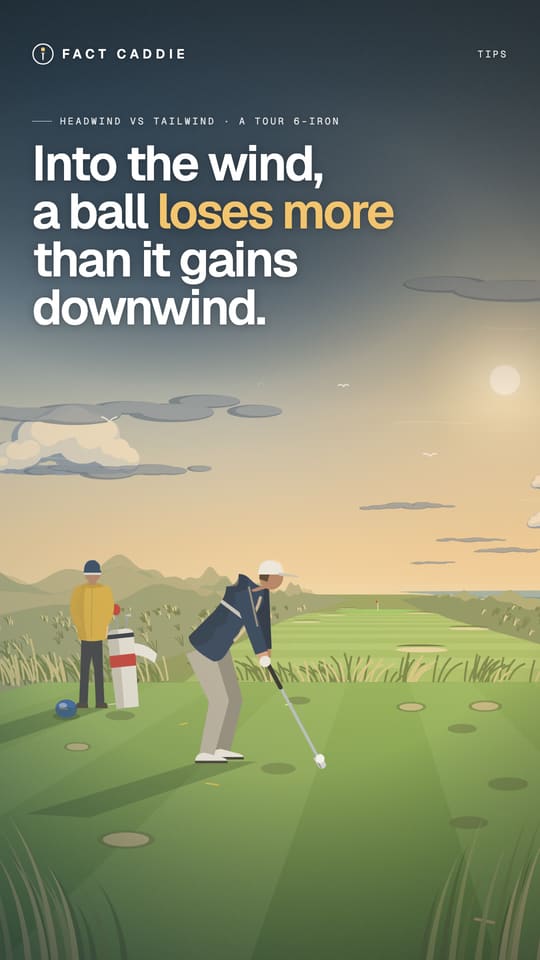
Into the wind, a ball loses more than it gains downwind.
In TrackMan's figures for a tour player's 6-iron, a constant 20 mph headwind takes 41 yards off the carry, while the same wind behind adds only 23. Faster air over the ball means more drag and more lift; downwind the ball loses lift and drops sooner.
The one to remember
Into the wind, more club and an easier swing keep the spin and the flight down.
Facts and sources
- TrackMan's wind table for a stock PGA TOUR 6-iron (ball speed 130 mph, launch 14.7°, spin 6,088 rpm, attack angle −3.1°; the same swing every time and a constant wind over the whole flight, which TrackMan calls an extreme case) carries 184 yards in calm air, 166 and 143 yards into 10 and 20 mph headwinds, and 198 and 207 yards with 10 and 20 mph tailwinds (TrackMan, 2014).
- Into the 20 mph headwind its peak height rises from 33.8 to 42.8 yards and it lands at 69.5° instead of 48°; with the wind behind it peaks at 26.1 yards and lands at 32.7°. The ball does not spin any faster into the wind (TrackMan).
- Drag and lift both grow with the square of the speed of the air past the ball (NASA Glenn; Dave Tutelman). A headwind adds to that airflow, so the ball meets more drag and more lift and balloons; a tailwind takes airflow away, so the ball loses lift and falls out of the air sooner, which is why the gain is smaller.
- All else equal, faster swings generate more spin, and more spin means more lift; clubs with less loft and slower, shorter swings reduce spin (TrackMan).
- At the 2024 Open at Royal Troon, Golf Digest's lesson from the pros was to club up and swing easy, and some pros reduced the loft on their clubs so they could swing softer and still hit their usual distances.
Illustration: the links hole, the golfer and caddie, the gallery and the weather are drawn, not a real course or player. The flights come from a simple drag-and-lift model tuned to TrackMan's 6-iron table (it matches the carries within about a yard, the peak heights within half a yard and the landing angles within about a degree); the air lines, the force arrows, the slowed spin, the higher flight of a harder swing and the low shot at the end are drawn to explain, not measured. TrackMan's table holds the wind constant over the whole flight, which it calls an extreme case.
Sources
- The Normalization feature explained · TrackMan, Trackman Editorial Team (9 July 2014) checked 11 October 2026
- 3 steps to improve your spin rate in golf · TrackMan, Trackman Editorial Team (18 August 2025) checked 11 October 2026
- Factors that Affect Drag · NASA Glenn Research Center, Beginner's Guide to Aeronautics checked 11 October 2026
- Ideal Lift of a Spinning Ball · NASA Glenn Research Center, Beginner's Guide to Aeronautics checked 11 October 2026
- What wind does to a drive · Dave Tutelman (29 December 2019, last modified 10 January 2020) checked 11 October 2026
- British Open 2024: 5 things I learned from pros at Royal Troon · Golf Digest, Luke Kerr-Dineen (22 July 2024) checked 11 October 2026
- Tips to hit solid golf shots into the wind · GOLFTEC (15 May 2018) checked 11 October 2026
The narration is AI-generated. Sources last checked 11 October 2026.
Script
A headwind costs a golf ball more distance than the same wind behind it gives back. In TrackMan's figures for a tour player's 6-iron, a 20 mph headwind takes off 41 yards. The same wind behind adds only 23. Into the wind, the air rushes over the ball faster. That means more drag, and more lift. The ball climbs nine yards higher, and drops in at almost 70 degrees. Downwind, the air flows past more slowly. The ball loses lift and comes down sooner, so it gains less. It doesn't spin any faster into the wind. But a harder swing adds spin, and more spin means more lift. So good players take more club, and swing easier. At the 2024 Open, some even took loft off their clubs, to swing softer and still hit their usual distances.