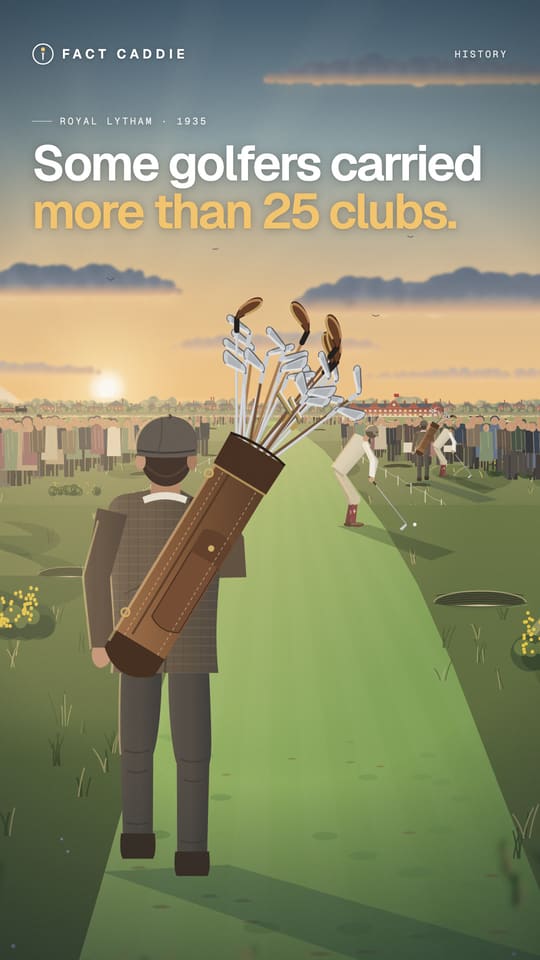
History · ROYAL LYTHAM · 1935
Some golfers carried more than 25 clubs.
In the 1930s some golfers carried more than 25 clubs; Lawson Little won the British and U.S. Amateurs of 1934 and 1935 with as many as 26. The USGA capped the bag at 14 in 1938 and The R&A a year later. In 2001 Ian Woosnam, tied for the Open lead, found a 15th club on the second tee.
The one to remember
A spare driver, a two-shot penalty, four shots behind.
Facts and sources
- The USGA limited players to 14 clubs from 1 January 1938, after years in which some players carried 30 or more specialised clubs; The R&A followed a year later (USGA, The R&A).
- Lawson Little won the Amateur Championship and the U.S. Amateur in both 1934 and 1935 (the 1935 Amateur at Royal Lytham & St Annes), often carrying as many as 26 clubs, seven of them wedges (World Golf Hall of Fame, The R&A).
- The USGA's historian Rand Jerris says surveys at the 1935 U.S. Open and U.S. Amateur found more than 18 clubs per player on average, and that the USGA's concerns were "de-skilling" the game, players who couldn't afford many clubs, and caddies carrying bags of more than 35 pounds. One player turned up in 1935 with 32 clubs, a full set for each hand (LINKS Magazine).
- No one knows for sure why the limit is 14; it matched the typical set of the time, four woods, nine irons and a putter (LINKS Magazine, Fairways Golf & Travel).
- In the last round of the 2001 Open at Royal Lytham & St Annes, Ian Woosnam, tied for the lead, hit his tee shot at the par-3 1st to six inches. On the 2nd tee his caddie, Miles Byrne, told him there were 15 clubs in the bag: two drivers. Woosnam threw the spare into a bush and took a two-stroke penalty, so the birdie became a bogey (The Open, The Globe and Mail).
- Woosnam finished tied for third, four shots behind David Duval, who won by three from Niclas Fasth (The Open).
Illustration: Royal Lytham & St Annes is drawn from its general look (a red-brick clubhouse, the railway beside the course, sandhills, gorse and bunkers), not surveyed. The 1935 gallery, Little's caddie, which 26 clubs he carried (only "as many as seven wedges" is recorded), the clubs laid out on the grass, the 2001 crowd, the rest of Woosnam's set and the throw are drawn to tell the story. The players are small figures seen from behind, with no attempt at a likeness.
Sources
- A Brief History of Revisions to the Rules of Golf: 1744 to 2016 · The R&A and the USGA checked 11 October 2026
- A Brief History of Revisions to the Rules of Golf: 1744 to Present · USGA checked 11 October 2026
- History of Equipment Rules · USGA checked 11 October 2026
- Lawson Little · World Golf Hall of Fame (read via the Internet Archive's copy of 4 December 2024; the live page refuses automated requests) checked 11 October 2026
- The Amateur Championship: past winners · The R&A checked 11 October 2026
- Why Only 14 Clubs? · LINKS Magazine (James A. Frank) checked 11 October 2026
- The Rules of Golf limit you to a maximum of 14 clubs. But why? · Fairways Golf & Travel (Peter Mumford, 19 June 2020, updated 12 April 2025) checked 11 October 2026
- 130th Open, Royal Lytham & St Annes 2001 · The Open (The R&A) checked 11 October 2026
- Woosnam blames caddy · The Globe and Mail (Michael Grange, 23 July 2001) checked 11 October 2026
The narration is AI-generated. Sources last checked 11 October 2026.
Script
In the 1930s, some golfers carried more than 25 clubs. Lawson Little won the British and American Amateurs in 1934 and 1935, with as many as 26 clubs in his bag. Caddies hauled bags of over 35 pounds, and the USGA worried that the clubs were taking skill out of the game. It set a limit of 14 clubs from 1938, and The R&A followed a year later. No one knows for sure why it was 14. A typical set then was four woods, nine irons and a putter. In 2001, Ian Woosnam began the last round of the Open tied for the lead. On the second tee, his caddie told him there were 15 clubs. A spare driver had been left in the bag. Woosnam threw it into a bush and took a two-shot penalty. He finished four shots behind.