History · MUSSELBURGH · 1829
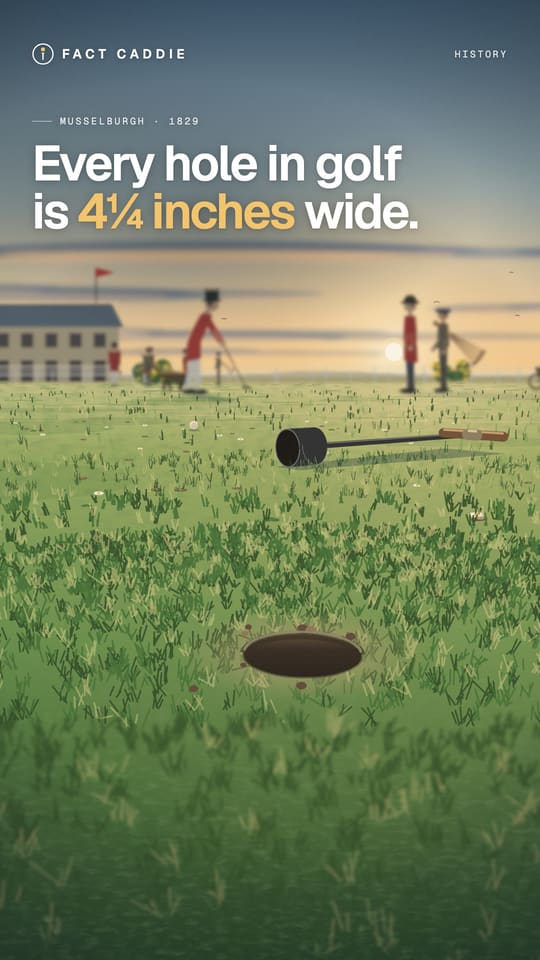
Every hole in golf is 4¼ inches wide.
Every golf hole is 4¼ inches across because in 1829 the golf club at Musselburgh paid a blacksmith £1 for a hole cutter that size, and the R&A made it the rule in 1891. In 1933 Gene Sarazen talked a Florida tournament into bigger holes; Paul Runyan, a great putter, won by ten shots.
The one to remember
Paul Runyan won by ten shots.
Facts and sources
- Before hole cutters, holes were cut by hand with a trowel, so their size varied from course to course and across a course (Golf Monthly, 2024).
- In 1829 the Musselburgh golf club (Royal Musselburgh since 1876) paid a local blacksmith, Robert Gay, £1 for "the instrument for forming holes" (club minutes, 13 March 1829). Its holes were 4¼ inches across. The club, at Prestongrange House near Prestonpans since 1925, keeps the cutter in its museum.
- The R&A's rules of 1891 set the hole at 4¼ inches in diameter and at least 4 inches deep. Today's Rules of Golf say the same (108 mm and 101.6 mm), and any lining must be sunk at least an inch below the surface.
- Gene Sarazen lobbied, unsuccessfully, for an eight-inch hole, so that putting would count for less (World Golf Hall of Fame; Golf Today).
- At his urging, the Miami Biltmore Open in Coral Gables, Florida, tried larger cups in March 1933 (reported as six inches; Runyan recalled eight). Paul Runyan, famous for his short game and putting, won with 266, ten shots clear of Charlie Guest.
Illustration: The Musselburgh links in 1829 (the racecourse rail and stand, the horses, the boats on the Firth, the golfers, their dress and the greenkeeper), the forge and the blacksmith, the coin, the cutter's look (after the club's surviving cutter), the rule book's page and room, the cut-away hole, Sarazen's shoes and putter, the Miami Biltmore green, its crowd and Runyan's putt are drawn to tell the story, not reconstructed. The 1933 holes are drawn larger than the regulation hole; reports give six inches, and Runyan remembered eight.
Sources
- The History · The Royal Musselburgh Golf Club checked 11 October 2026
- History 1828 – 1899 · The Royal Musselburgh Golf Club checked 11 October 2026
- What Size Is The Golf Hole – And Why? · Golf Monthly (Roderick Easdale), 27 August 2024 checked 11 October 2026
- 1672 Musselburgh, The Lawyer Golfer · Scottish Golf History checked 11 October 2026
- History of the Hole Cup · The Bull Sheet (Midwest Association of Golf Course Superintendents), Brad Earl Anderson, October 1984, via MSU Turfgrass Information Center checked 11 October 2026
- Tin cup · Greenkeeper International (BIGGA), Tim Webb, October 2010, via MSU Turfgrass Information Center checked 11 October 2026
- The Rules of Golf, being the St. Andrews Rules for the game, codified and annotated (J. Norman Lockyer and W. Rutherford) · Macmillan, 1896, via Internet Archive checked 11 October 2026
- A Brief History of Revisions to the Rules of Golf: 1744 to 2016 · The R&A and the USGA checked 11 October 2026
- Rules of Golf, Definitions: Hole · The R&A (Rules of Golf, 2023 edition, in force until the 2027 edition) checked 11 October 2026
- What size is the golf hole, and why? · Golf Today (Simon Bale), 8 May 2018 checked 11 October 2026
- Gene Sarazen · World Golf Hall of Fame checked 11 October 2026
- Paul Runyan, esencia en frasco pequeño · Ten Golf (Spain) checked 11 October 2026
- Paul Runyan (Who's who) · where2golf checked 11 October 2026
- Looking Back: Coral Gables Open on PGA Tour; Paul Runyan: PGA Champ, Short-Game Wizard · Golf Compendium checked 11 October 2026
- Coral Gables Open Invitational · Wikipedia (citing the Associated Press, "Runyan Wins First Money at Miami", The Evansville Courier, 7 March 1933) checked 11 October 2026
The narration is AI-generated. Sources last checked 11 October 2026.
Script
Every golf hole in the world is 4¼ inches wide, because of a tool from 1829. Before then, holes were dug with a trowel, and their size changed from green to green. At Musselburgh, near Edinburgh, the local club paid a blacksmith one pound for a hole cutter. It made every hole 4¼ inches across. In 1891, the R&A made that size the rule. The same rule says the hole must be at least four inches deep. Gene Sarazen wanted an eight inch hole, so putting would count for less. In 1933, he talked a tournament in Florida into trying bigger holes. Paul Runyan, one of the best putters in the game, won it by ten shots.